



1 Summary
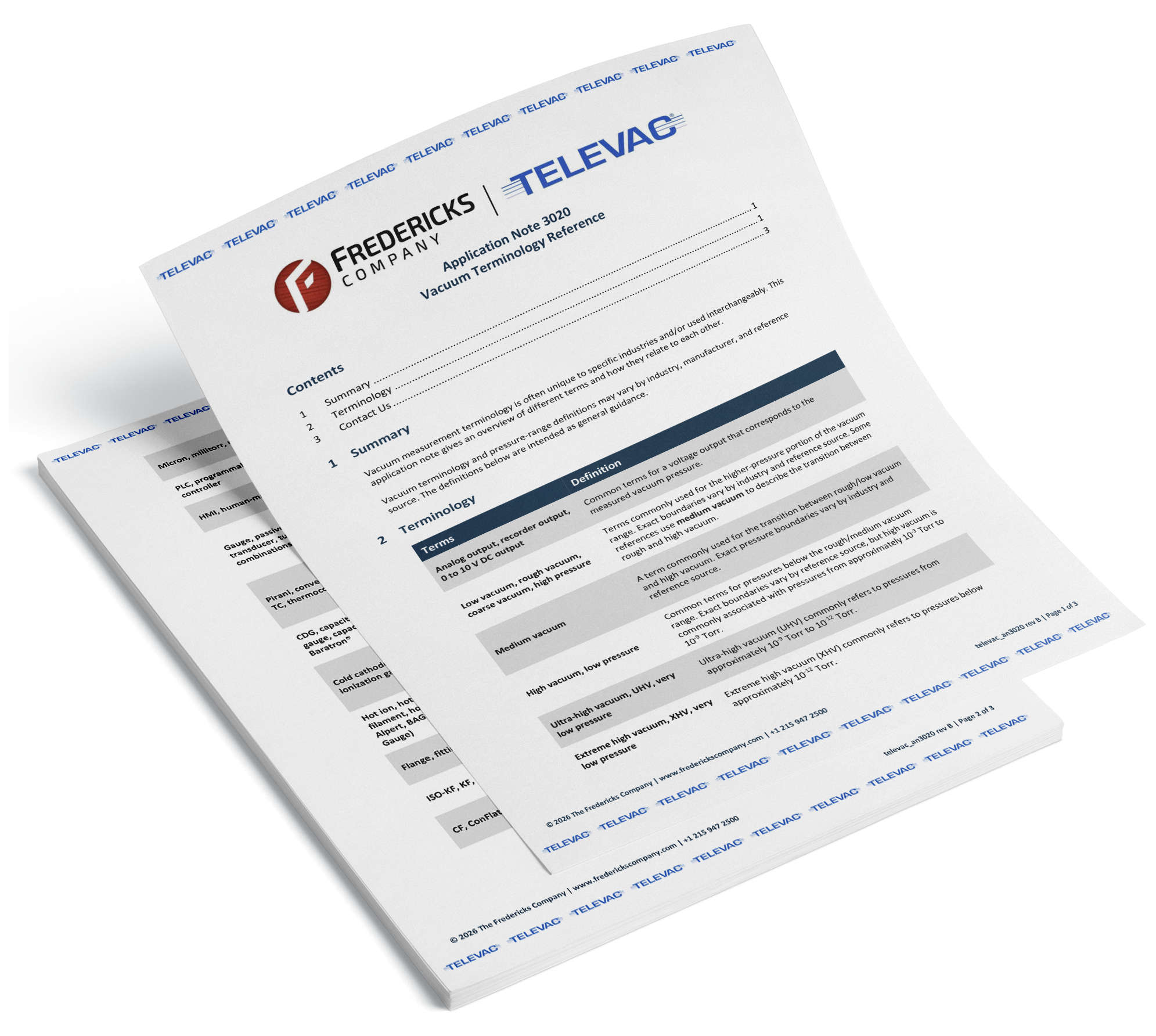
Vacuum measurement terminology is often unique to specific industries and/or used interchangeably. This application note gives an overview of different terms and how they relate to each other.
Vacuum terminology and pressure-range definitions may vary by industry, manufacturer, and reference source. The definitions below are intended as general guidance.
Back to Table of Contents2 Terminology
| 용어 | Definition |
|---|---|
| Analog output, recorder output, 0 to 10 V DC output | Common terms for a voltage output that corresponds to the measured vacuum pressure. |
| Low vacuum, rough vacuum, coarse vacuum, high pressure | Terms commonly used for the higher-pressure portion of the vacuum range. Exact boundaries vary by industry and reference source. Some references use medium vacuum to describe the transition between rough and high vacuum. |
| Medium vacuum | A term commonly used for the transition between rough/low vacuum and high vacuum. Exact pressure boundaries vary by industry and reference source. |
| High vacuum, low pressure | Common terms for pressures below the rough/medium vacuum range. Exact boundaries vary by reference source, but high vacuum is commonly associated with pressures from approximately 10-3 Torr to 10-9 Torr. |
| Ultra-high vacuum, UHV, very low pressure | Ultra-high vacuum (UHV) commonly refers to pressures from approximately 10-9 Torr to 10-12 Torr. |
| Extreme high vacuum, XHV, very low pressure | Extreme high vacuum (XHV) commonly refers to pressures below approximately 10-12 Torr. |
| Micron, millitorr, mTorr | Equivalent pressure units. 1 micron = 1 mTorr = 0.001 Torr = 10-3 Torr. |
| PLC, programmable logic controller | An industrial controller used to automate equipment and process logic. |
| HMI, human-machine interface | A user interface or display used to monitor and control a vacuum system or other automated equipment. |
| Gauge, passive gauge, sensor, transducer, tube, or combinations of these terms | These terms are often used loosely for a vacuum-sensing device. For clarity, Televac® uses passive vacuum gauge for a sensing element without integrated measurement electronics and active gauge for a gauge that includes integrated electronics. Passive gauges may be preferred in applications where radiation or other environmental conditions make local electronics undesirable. |
| Pirani, convection, Convectron®, TC, thermocouple | These are all types of thermal conductivity vacuum gauges, but they are not identical technologies. Pirani, convection-enhanced Pirani, and thermocouple gauges use different methods to determine pressure from gas-dependent heat transfer. TC is an abbreviation for thermocouple. |
| CDG, capacitance diaphragm gauge, capacitance manometer, Baratron | CDG, capacitance diaphragm gauge, and capacitance manometer are commonly used names for the same general measurement technology. Baratron® is a registered trademark of MKS Instruments, Inc. for its capacitance manometers. |
| Cold cathode, CC, cold-cathode ionization gauge, Penning gauge | Terms associated with cold-cathode ionization gauges. A Penning gauge is a type of cold-cathode ionization gauge. The broader terms ionization gauge or ion gauge can refer to either cold-cathode or hot-cathode technologies and therefore are not exact synonyms for cold cathode. |
| Hot ion, hot ionization, hot filament, hot cathode, Bayard-Alpert, BAG (Bayard-Alpert Gauge) | Terms commonly associated with hot-cathode ionization gauges. The Bayard-Alpert gauge is a widely used hot-cathode ionization gauge design, but not all hot-cathode gauges are Bayard-Alpert gauges. |
| Flange, fitting | Related terms that are sometimes used interchangeably. A flange or fitting provides the mechanical interface between a vacuum-system port and a vacuum gauge or other vacuum component. |
| ISO-KF, KF, QF, quick flange, NW | Common names and designations associated with the ISO-KF small-flange system. The accompanying size designation indicates the nominal flange size; for example, DN 25 ISO-KF or NW25. |
| CF, ConFlat | Common names for a knife-edge, metal-gasket vacuum flange system frequently used in high-vacuum and ultra-high-vacuum applications. |