




1 Description
The use of an inclinometer can improve the long-term positioning accuracy of a solar tracking system by providing a reliable absolute angular measurement.
Read the following three common misconceptions to learn more about the advantages of using an inclinometer in your solar tracker.
Back to Table of Contents2 Misconception #1
Our systems use calculations based on the sun’s location and this formula is built into our tracker module so there is no need for an inclinometer.
Response
The algorithm (software program) is actually needed as a part of a closed-loop measuring system. But without an absolute measuring device such as an inclinometer (tilt sensing device) you really don’t know if the solar collector (be it module or panel) is truly pointing in the right direction. The algorithm tells the system where to point, and the inclinometer confirms that the system is indeed pointing in the correct direction. One can think of the algorithm as a map and the inclinometer as feet on the ground giving feedback.
There are conditions that can affect whether the solar collector is pointing properly, and an open-loop system may not be able to detect these conditions. The following conditions can be detected or compensated for in a closed-loop system:
Seismic movement of the solar collector/foundation: A good utility-scale solar generator should be designed for at least a twenty-year service life. However, conditions can change over that period. If the system simply drives the collector some number of steps or counts, the position is simply inferred and not known. On the other hand, an inclinometer positioned on the collector gives the system an absolute position.
Wind buffeting: Utility-scale solar collectors are large devices in which prevailing winds can induce mechanical and angular offsets. Without an absolute sensor, such as an inclinometer, indicating the true angle, these offsets can affect the angular position. Again, an open-loop system with no feedback cannot compensate for the prevailing wind condition.
Lost transmission data: Sometimes data transmission can get corrupted or lost. Having an inclinometer onboard serves (as mentioned above) as a checking standard for knowing if you are pointing where you want to be pointing.
Lost power: This condition is very similar to lost transmission data. If there is no checking standard, such as an inclinometer to give feedback, then under a lost power scenario the system must be recalibrated, thus causing lost operational time. This might be done by going back to stow position and setting off reset switches, etc. The use of an inclinometer gives the absolute angular position as soon as power is returned. This can eliminate the need to reset the system and reduce the need for costly recalibration.
Back to Table of Contents3 Misconception #2
Our tracker system uses photodiodes and calculations based on the sun’s location. If the photodiodes detect no sunlight, the software repositions the tracker to find its correct position during these periods; therefore, I do not need an inclinometer.
Response
Photodiodes are used to detect the sun. They are a form of an absolute sensor, but they have shortcomings when it comes to placing the solar module in a stow position (which a good inclinometer-based system can accomplish). When clouds obscure the sun, the photodiode may no longer provide usable position feedback, requiring the tracking system to rely on its positioning algorithm. Wind may also induce an angular offset. If clouds simultaneously obscure the sun, the photodiodes cannot provide position feedback, causing the system to rely on an algorithm that cannot account for the wind-induced deflection. This creates a compounded positioning problem that can be avoided by using an inclinometer-based feedback system.
Back to Table of Contents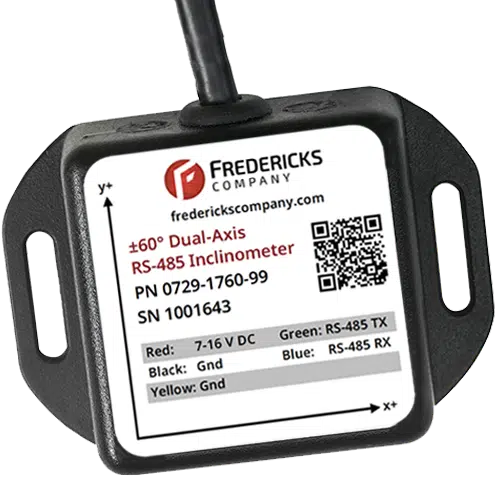
4 Misconception #3
Nous utilisons des codeurs absolus et des logiciels et n'avons pas besoin d'inclinomètre.
Response
An absolute encoder is like an inclinometer in that it doesn’t lose its position in case of power outage. Like an inclinometer, an absolute encoder can provide position information after a loss of power without requiring the system to reestablish position from incremental counts.
This is a viable but costly approach. An absolute encoder with a resolution of 0.003 degrees is very expensive. An electrolytic dual-axis tilt sensor is available at a fraction of the cost and is by its nature a two-axis product. A typical rotary encoder measures a single axis.
A good absolute encoder may provide 17-bit resolution, which divides a 360-degree circle into 131,072 counts. A dual-axis electrolytic tilt sensor (within its measuring range) resolves easily to 0.05 degrees, which is equivalent to 180,000 counts.
Traditional shaft-driven rotary encoders may include moving mechanical components that are subject to wear. Unlike an inclinometer, which can be mounted directly to the solar collector and measure its angular position relative to gravity, a shaft-driven encoder reports the position of the mechanical linkage to which it is connected.
Back to Table of Contents5 In Conclusion
The simple elegance of the inclinometer is the sensor’s inherent ability to output an absolute angular position in one or two planes by simply being attached to the solar collector.
Back to Table of Contents